
The Story Behind an Award-Winning Photograph, Explained
The Story Behind an Award-Winning Photograph, Explained
Summary: An award-winning photograph rarely wins on technical perfection alone. It earns recognition because a compelling narrative, genuine emotion, strong composition and originality converge in a single frame. Understanding how those elements work together helps photographers move from beautiful pictures toward images that resonate with juries and audiences alike.
In 2026, the World Press Photo Contest received more than 57,000 entries, yet only a handful of images reached the world stage. That gap between thousands of technically sound photographs and the rare frame that stops a jury reveals a simple truth: the story behind an award winning photograph matters as much as its sharpness or exposure. What separates a good picture from a decorated one is meaning. If you want to understand what makes an award-winning photograph, you have to look past the surface.
Great images carry a narrative that continues after the shutter closes. According to PetaPixel, the 2026 World Press Photo of the Year, Carol Guzy’s “Separated by ICE,” was celebrated less for its technique than for the human weight it carried. This is the lesson worth studying: the frames that endure are the ones with something to say.
Why the Narrative Behind the Frame Wins Awards
Consider what a jury actually experiences. Members review thousands of submissions, and most images blur together within seconds. The photographs that survive are those that provoke a question, an emotion or a memory. A strong visual narrative gives the viewer a reason to linger, and lingering is the first step toward recognition.
The scale of modern competitions makes this clear. World Press Photo reports that the 2026 winners were chosen from 57,376 photographs submitted by 3,747 photographers across 141 countries. In a field that large, technical competence is assumed. The deciding factor is whether an image tells a story that feels urgent, honest and impossible to ignore.
Storytelling is not limited to photojournalism. A portrait, a landscape or an abstract composition can carry narrative through mood, symbolism and context. If you want to deepen this skill, our essay on the power of visual storytelling in contemporary art examines how meaning travels across genres.
The Elements Juries Weigh Beyond Technique
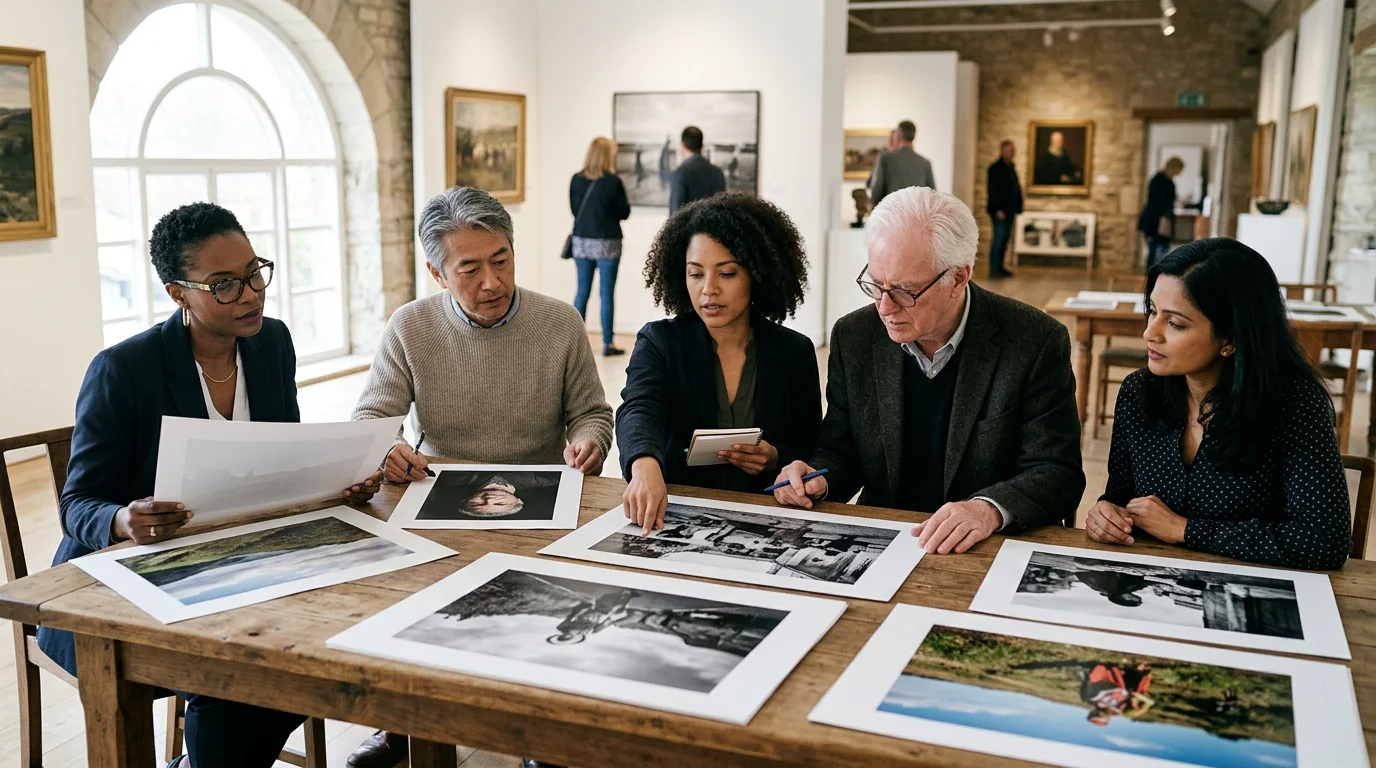
What exactly does a professional jury look for? Technical quality opens the door, but it does not win the room. Strong photographs are evaluated across several intertwined dimensions, and a memorable image usually excels in more than one.
- Emotion: the capacity to make a viewer feel something immediate and genuine.
- Originality: a perspective, subject or treatment that has not been seen a thousand times before.
- Composition: the deliberate arrangement of light, line and space that guides the eye.
- Storytelling: the sense that the frame belongs to a larger truth or moment.
- Visual impact: the force that registers before the viewer has time to analyze.
These criteria are not a checklist to satisfy mechanically. They describe how a strong image behaves in front of an experienced eye. A technically flawless photograph with no emotional pull will lose to a slightly imperfect frame that moves the viewer. If you are curious about how these factors translate into results, our guide on what it takes to become a photography contest winner breaks the process down further.
How Context Transforms a Single Image
A photograph does not exist in isolation. Its power often depends on the circumstances of its making and the moment it captures. The most decorated images tend to sit at the intersection of a personal vision and a wider human reality.
This is why competitions increasingly value proximity and authenticity. DIY Photography notes that 31 of the 42 World Press Photo winners in 2026 were local to the region they photographed. Nearness to a subject, lived understanding and sustained commitment give an image a depth that a fleeting visitor rarely achieves. The context becomes part of the composition.
The photographs that endure are rarely the ones that were easiest to take. They are the ones the photographer understood most deeply.
History confirms the pattern. Many of the most celebrated frames of the past century, from conflict zones to quiet domestic moments, earned their status because they distilled a complex situation into one legible image. The photographer’s relationship with the subject, whether built over months or seized in a single decisive instant, shapes what the final frame can communicate.
Learning From the Masters of the Decisive Moment
Studying the photographers who defined the craft is one of the most efficient ways to sharpen your own eye. Their work demonstrates how courage, patience and intention combine to produce images that outlast the events they record.
The history of documentary photography is full of practitioners who placed themselves at the center of danger to bear witness. Our profile of Robert Capa and the lens at the heart of danger explores how proximity and risk shaped some of the most influential frames ever published. The lesson is not to imitate the danger, but to adopt the commitment.
Contemporary competitions also reward emotional range. My Modern Met observes that the 2026 award-winning stories spanned political upheaval, climate crisis, cultural tradition and quiet human resilience. The breadth is a reminder that no single subject guarantees success. What matters is how completely you inhabit and communicate whatever story you choose.
Building Your Own Award-Worthy Story
How do you apply these principles to your own practice? Start by choosing subjects you genuinely understand, then commit to them beyond a single visit. Depth almost always beats novelty.
- Define the message. Before you shoot, ask what you want the viewer to feel or realize.
- Return to your subject. The strongest frames often come after repeated encounters, not first impressions.
- Refine the composition. Remove every element that does not serve the story.
- Edit ruthlessly. One decisive image outperforms a diluted series of near-misses.
- Seek honest feedback. Submit your work to juried competitions to test it against expert eyes.
Recognition also plays a practical role. Placing your work in front of an international jury sharpens your judgment and builds an audience. If you are ready to test your strongest frame, we invite you to submit to the international competition we run at Art Vision Awards, where an international jury reviews entries for quality, originality, emotion and visual impact.
How Modern Competitions Compare
Not every competition offers the same recognition. The table below compares common features so you can choose where your work belongs, with our own program included for context.
| Feature | Art Vision Awards | Large photojournalism contests | Genre-specific awards |
|---|---|---|---|
| Jury review | International professional jury on quality, originality and impact | Regional and global juries | Specialist panels |
| Editorial publication | Yes, in AVA Magazine | Sometimes | Varies |
| Entry flexibility | Plans of 1, 4 or 7 entries | Fixed categories | Fixed categories |
| Recognition assets | Digital certificates, winner logos, profile badges | Certificates | Certificates |
| Premium prizes | Cash prizes, physical statuette, ceremony invitation | Cash and equipment | Varies |
The right competition depends on your goals. If international visibility, editorial publication and a professional evaluation matter to you, a jury-based program offers a clear path forward.
Final Thoughts on Winning Frames
The story behind an award-winning photograph is never accidental. It is the product of intention, emotional honesty, careful composition and a subject the photographer truly understands. Technical mastery remains essential, yet it serves the narrative rather than replacing it. As you develop your own work, focus on what you want an image to say, return to your subjects with patience, and edit toward the single frame that carries the most meaning. Recognition follows clarity of vision, not the other way around.
Take action with Art Vision Awards
You have studied what elevates an image from competent to unforgettable. The next step is to place your strongest work in front of people equipped to judge it. Testing your vision against an experienced international jury is one of the most direct ways to grow as a photographer and gain visibility.
We run the International Photography Competition 2026, where photographers and visual artists worldwide submit their work for review by an international professional jury. Selected entries can receive cash prizes, digital certificates, editorial publication in AVA Magazine and social media visibility, while premium placements include a physical statuette. Discover our international photography awards competition and start for free.
Frequently Asked Questions
What makes a photograph win an award?
Winning photographs combine technical quality with emotion, originality, strong composition, storytelling and visual impact. Juries reward images that communicate a clear narrative and provoke a genuine response, rather than technically perfect frames with no meaning.
Does the story really matter more than technique?
Technique opens the door, but narrative wins the room. Among tens of thousands of technically sound entries, the images that resonate emotionally and tell a compelling story are the ones that reach the final rounds of major competitions.
How do professional juries evaluate submissions?
At Art Vision Awards, our international jury reviews entries for quality, originality and visual impact. Members weigh how effectively an image communicates, how fresh its perspective is, and how strongly it registers before analysis begins.
Do I need expensive equipment to create an award-winning image?
No. Many celebrated photographs were made with modest gear, and some winners have used action cameras or simple setups. What matters most is vision, timing and the strength of the story you capture, not the price of your equipment.
How can I improve my chances in a photography competition?
Choose subjects you understand deeply, return to them repeatedly, and edit toward your single strongest frame. Seeking expert feedback through juried competitions helps you measure your work against professional standards and refine your eye over time.


Comments are closed.