Photography Contests: How to Choose and Win in 2026
Summary: Photography competitions reward strong, original images with cash prizes, editorial publication, and international exposure. Choosing the right event means matching your portfolio to the theme, jury, and category. In 2026, the leading global contests attract tens of thousands of entries from more than one hundred countries, so a considered, well prepared submission is what separates finalists from the crowd.
Consider a single number: one leading global competition recently drew more than 430,000 entries from over 200 countries and territories. That scale explains why photography contests have become a defining route for photographers who want recognition beyond their immediate audience. Whether you are an emerging talent or an established professional, a well placed submission can reshape how your work is seen. If you are planning your entries for the year, our photo contest for 2026 is one way to place your images in front of an international jury.
The appeal is easy to understand. Competitions expose your work to new audiences, connect you with curators and editors, and provide external validation that is difficult to earn elsewhere. According to Photo Contest Insider, the strongest results tend to come from a cohesive body of work rather than a single striking frame. Understanding how these events operate is the first step toward entering them with confidence.
Why photography competitions matter for your development
Recognition is only part of the value. Entering a competition forces you to review your archive critically, select your strongest frames, and present them with intent. That editorial discipline is a skill in itself, and it compounds over time.
There are three practical benefits worth weighing before you enter any photo competition:
- Visibility: finalists and winners are frequently published, exhibited, and shared across editorial and social channels.
- Credibility: a placement judged by a professional panel carries weight with clients, galleries, and publications.
- Growth: comparing your work against an international field reveals where your craft can improve.
Prize money matters, but the lasting return is usually reputational. A single award can open doors that years of self promotion do not. If you are unsure which subjects suit your style, our overview of photography contest themes can help you align your portfolio with the right category.
The landscape of international photo competitions in 2026
The scale of participation continues to grow. The official organizers report that the 2026 World Press Photo Contest selected its winners from 57,376 photographs entered by 3,747 photographers across 141 countries. That breadth reflects how accessible international recognition has become.
Participation is also diversifying. In the same 2026 edition, women and non-binary photographers made up 22% of contest entries, a figure the organizers describe as part of a steady increase. Entrant numbers from South America rose 11% compared with the 2025 contest, while Asia-Pacific and Oceania grew by 14%.
Beyond photojournalism, the field spans wildlife, fine art, portrait, landscape, and mobile photography. The 2026 edition of the Wildlife Photographer of the Year, according to Photo Contest Insider, received over 60,000 entries from 113 countries. The international photography awards circuit now offers a route for almost every genre and skill level.
How to choose the right competition for your work
More entries do not mean better odds. The photographers who place consistently are those who select events that genuinely fit their portfolio, rather than entering everything within reach.
Work through four questions before you commit:
- Does the theme fit? A conservation focused contest rewards different images than a fashion or architecture award.
- Who is judging? The jury shapes what wins. Research their backgrounds and past selections.
- What is the category structure? Some events, such as the long running APOY, run across many rounds and categories. As Amateur Photographer notes, photographers from 74 countries entered over 9,000 images in a recent edition.
- What is the prize actually worth? Cash is only one element. Exhibition, publication, and exposure often matter more.
Reading past winning entries is the single most useful preparation you can do. It reveals the technical standard and the editorial taste of each event. When you are ready to narrow your shortlist, our photography awards are structured across clear categories so you can identify where your work belongs.
Entry fees, prizes, and understanding real value
Cost structures vary widely. Some competitions are free to enter, while others charge per image or per category. A free contest may attract a larger field, whereas a paid one can offer more substantial prizes and curation.
The table below compares typical models so you can judge value rather than headline prize figures alone.
| Competition type | Entry model | Cash prize | Editorial publication | Physical award |
|---|---|---|---|---|
| Free mass-entry contests | No fee, high volume | Variable, often modest | Occasional | Rare |
| Prestige genre awards | Per image or category fee | Higher, single top prize | Selected winners | For top placements |
| Art Vision Awards (ours) | Plans of 1, 4, or 7 entries | Up to €2,500, with tiered breakdown | AVA Magazine feature | Physical statuette for premium winners |
Our prize breakdown is transparent: €1,000 for first place, €500 for second, €200 for third, and €100 for fourth through tenth. Selected works are considered for editorial publication in AVA Magazine, and premium winners receive a physical statuette. When you weigh any entry fee, measure it against exposure and publication, not prize money alone.
How to prepare a submission that stands out

A jury may review thousands of images in a short window. Your first task is to survive the initial glance, which is often made at a small preview size. Choose frames that read clearly and hold their impact when reduced.
Several principles apply across almost every event:
- Curate ruthlessly. Submit your strongest images only. One weak frame can undermine a set.
- Respect the brief. Read the rules on editing, dimensions, and eligibility, then follow them exactly.
- Tell a story. Where a series is allowed, sequence images so they build a coherent narrative.
- Title with care. A precise caption can add context that a jury values.
Free-to-enter professional competitions raise the standard further. The Hasselblad Masters 2026, for example, is judged on creativity, composition, technical skill, and concept, which mirrors the criteria most international juries apply. For a detailed walkthrough of the process, our guide on how to prepare a strong submission covers file preparation, sequencing, and presentation.
Turning competitions into momentum
Entering photography competitions is not about chasing every deadline. It is about selecting the events that fit your vision, presenting a curated and considered set, and treating each result as feedback. The global field is large and diverse, which means there is room for many styles and stages of career. Approach each entry with intent, learn from the images that place, and let recognition build on itself over time.
Take action with Art Vision Awards
You have a portfolio and a clear idea of the recognition you are seeking. The next step is placing your images where a professional, international jury can evaluate their quality, originality, and visual impact.
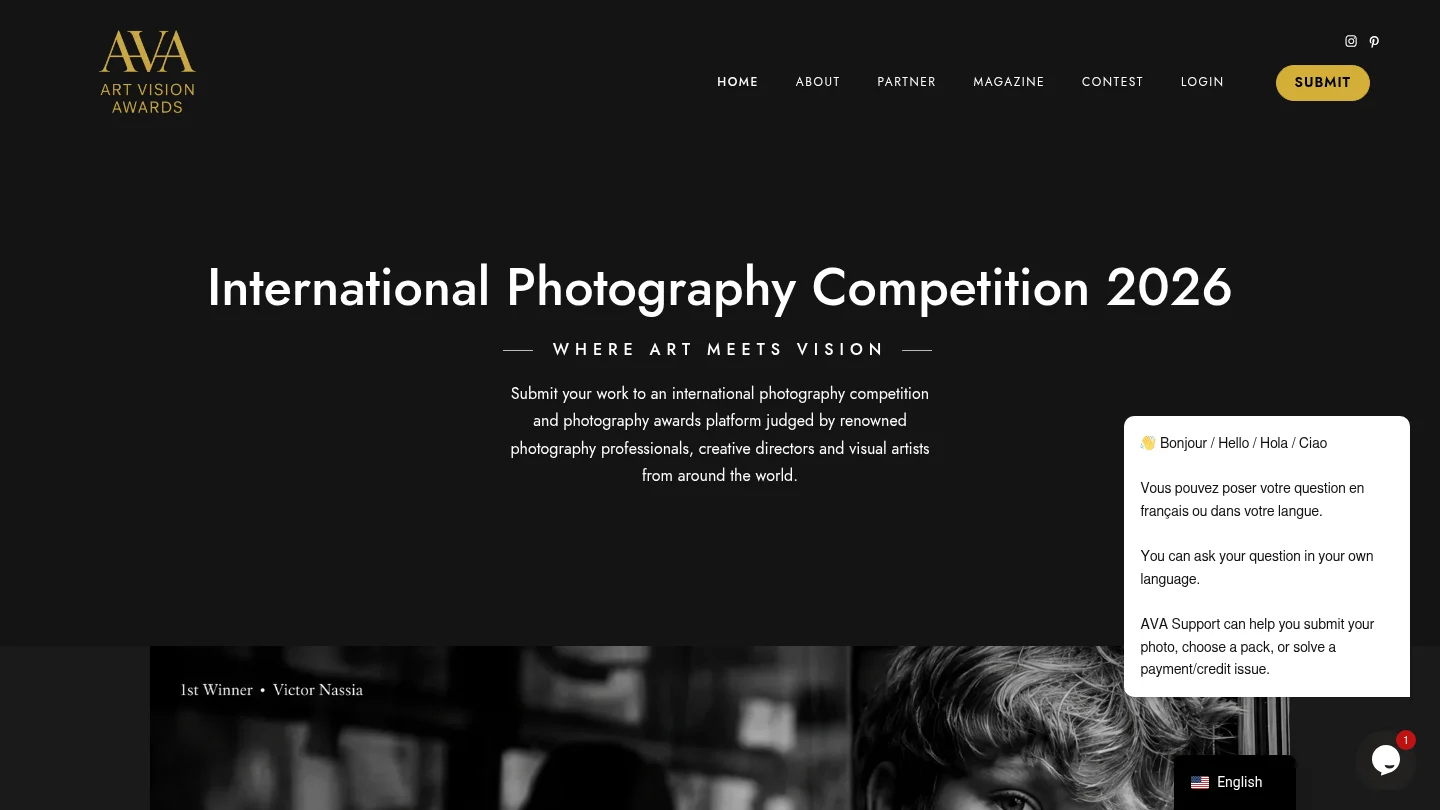
We invite you to enter the Art Vision Awards 2026 competition, where photographers and visual artists worldwide submit their work for jury review. Selected entrants can receive cash prizes, awards and certificates, editorial publication in AVA Magazine, and social media visibility, with premium placements tied to a physical statuette and an invitation linked to the ceremony in Cannes. You may start for free and subscribe to receive updates about the competition and jury announcements.
Frequently Asked Questions
Are photography competitions worth entering for amateurs?
Yes. Many international competitions include non-professional, student, or open categories that welcome newcomers. Entering helps you benchmark your work against a global field and earn early recognition.
Do I have to pay to enter a photo competition?
It depends on the event. Some competitions are free, while others charge per image or per category. Paid contests often provide larger prizes, curation, and editorial exposure that free contests may not.
How many images should I submit?
Submit only your strongest work rather than filling every available slot. With our submission plans, you may choose to enter one, four, or seven images, so you can match your entry to the images you are truly confident in.
What do juries look for in a winning image?
Most international juries assess quality, originality, composition, technical skill, and concept. A clear narrative and an image that holds its impact at small preview sizes will stand out during the first round of review.
What can winning a competition actually do for my career?
A placement can lead to editorial publication, exhibition, and greater visibility with clients and curators. The reputational return often outlasts the prize money and can open opportunities that self promotion alone rarely reaches.


Comments are closed.